Overview

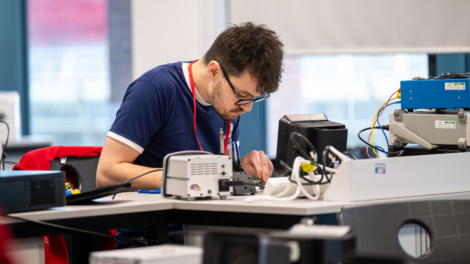
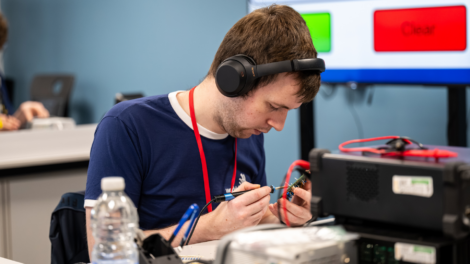
Electronics is used in almost every aspect of life. Including consumer electronics, mobile communication, medical electronics, industrial electronics and so much more.

Electronic engineers are responsible for designing, building and repairing electronic systems in the fields mentioned above.

Careers in electronics are incredibly diverse. After studying core electronics including analogue systems, digital systems and coding there are several specialist routes that could be followed. Suffice to say that all electronic systems use what is called embedded systems. This encompasses all aspects of electronics into one final project solution for the given area of specialism.

The skills you need to demonstrate

  • Problem solving

  • Time management

  • Working well under pressure

  • Creativity

  • Analysis and design of various circuits

  • Hardware design

  • Embedded Systems Programming

  • Fault Finding, Repair and Measuring Module

Prepare for competition success

Our library of endorsed local skills competition briefs ‘benchmarking assessments’ helps prepare learners to build technical skills, productivity, and mindset competencies for national competition success, including employability progression pathways.

Paired with the benchmarking tracker, educators can record progress, identifying strengths and target areas for improvement. Together, they offer a reliable, standards-led framework, creating a sustainable model for skills development that supports educators to empower learners to be competition ready.
Contact details

Entry criteria

  • Entry qualifications for the skills competition are qualified to a maximum of level 3.
  • Industrial experience is not essential but potentially advantageous.
  • There will be training provided by the competition organising partner at all levels of the competition.
  • The skill is an individual skill which will require studying the following:
    • Circuit design.
    • Printed Circuit Board Design.
    • Arduino coding.
    • Fault Finding.
    • Soldering.
  • Competitors must be familiar with the core competencies (these can be found in the National Standard of Excellence in the ‘Useful resources’ section).

How it works

Registrations open on Monday 2 March 2026, 9am and will close Friday 27 March 2026, midnight.

Entry Stage will be released on Monday 3 March with a final deadline of 10 April, 2025.

Qualifiers will run through late May and early June dates to be confirmed.

Venues:
Wales (Gower College Swansea) May
Gloucester (GET) May
Sheffield (Sheffield University) June
Northern Ireland (Belfast Metropolitan College) June
Scotland (Glasgow Clyde College) June

To help finalists prepare ahead of the UK Final, we will provide relevant technical training and share mindset development techniques, to support them to remain focused on achieving success.

Prepare students and apprentices by engaging with our benchmarking resources to master their skills and mindset masterclasses to build confidence and resilience on the WorldSkills UK Learning Lab.

The National Finals are scheduled to take place in Wales during the week commencing 16 November 2026.

Competitors who are age eligible and have achieved the benchmark score will be invited to opt into Squad UK for the WorldSkills 2028 cycle, subject to the skill progressing to the international competition cycle.

Our gallery

Sign up to receive our latest updates to your email

Subscribe